Platform first
FLUREXIS™ narrows the project to the correct treatment universe without forcing an early product choice.
COMMERCIAL TECHNOLOGY PLATFORM
Fluid Conditioning Technologies
Industrial hydraulic- and lubrication-fluid conditioning for solid contamination, water and selected oil-degradation products.
FLUREXIS™ organizes fluid conditioning by the contamination mechanism that must be controlled. HYLTRIS™ and LUBREVA™ address solid-particle cleanliness in hydraulic and lubrication circuits, DEWATIS™ addresses water in its relevant forms, and OILREVEX™ addresses selected degradation products that conventional particulate filtration does not resolve. Selection follows fluid chemistry, viscosity and temperature, flow and pressure duty, cleanliness objective, water state, degradation mechanism, equipment sensitivity and the required verification method.
PLATFORM ROLE
Industrial hydraulic- and lubrication-fluid conditioning for solid contamination, water and selected oil-degradation products.
FLUID CONDITIONING SCOPE
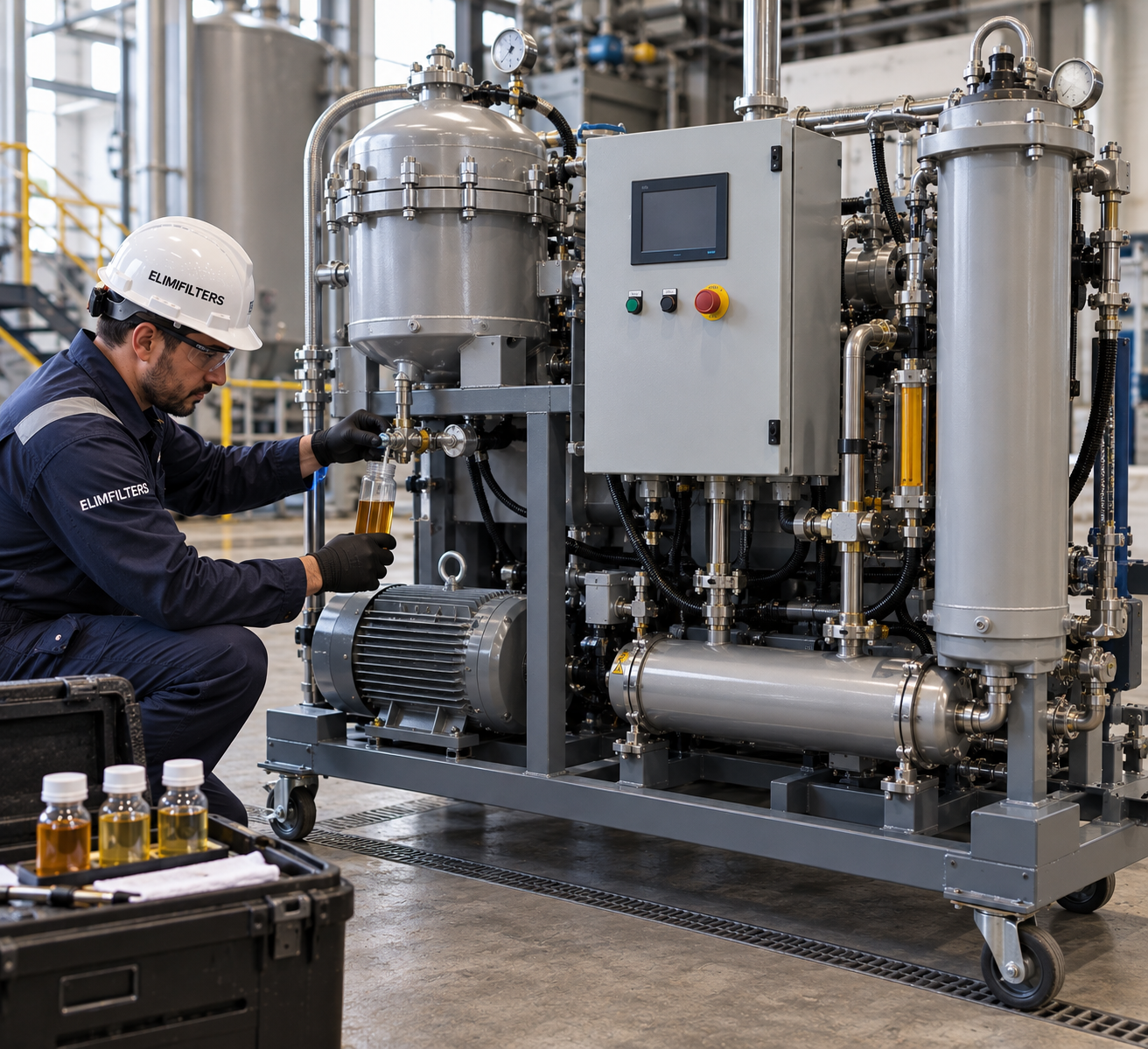
FLUREXIS™ separates particulate control, water removal and oil-condition remediation so treatment begins with the actual fluid problem instead of a generic filter form.
For hydraulic systems where solid contamination, ingression and wear debris must be controlled around component sensitivity, cleanliness objectives, pressure duty and flow behavior.
For circulating and industrial lubrication systems where wear debris and ingressed solids must be controlled while respecting oil viscosity, temperature, flow and bearing or gear sensitivity.
For oils affected by free, emulsified or dissolved water, with the treatment method selected from water form, oil properties, contamination level and required final moisture condition.
For confirmed degradation products, varnish precursors, sludge-forming contaminants or chemistry-related conditions that are not resolved by conventional particulate filtration alone.
TECHNOLOGY FAMILIES
Hydraulic Fluid Filtration
Particulate contamination control for industrial hydraulic systems where component reliability depends on sustained fluid cleanliness under real pressure, flow and viscosity conditions.
Industrial Lubrication Filtration
Industrial lubricating-oil particulate control for circulating systems, gearboxes, bearings and turbine or machinery lubrication duties.
Oil Dehydration & Water Removal
Water-removal treatment for hydraulic and lubricating oils where free, emulsified or dissolved water is degrading fluid condition or equipment reliability.
Oil Condition Remediation
Targeted remediation for selected oil-degradation products and chemistry-related contaminants that conventional particulate filtration alone does not resolve.
OPERATING REALITY
Flow, pressure, temperature, chemistry, contaminant form, duty cycle, compatibility, existing equipment and required outlet condition determine which treatment family and physical configuration belong in the project.
FLUREXIS™ narrows the project to the correct treatment universe without forcing an early product choice.
The family page defines the mechanism, application context and evidence required before replacement-element or treatment-media specification.
ELIMFILTERS PRODUCT SCOPE
ELIMFILTERS Industrial & Process is centered on validated filtration, separation and treatment media and replacement elements. Housings, pressure vessels, collectors, skids, pumps, fans, ductwork, controls and other process equipment shown or referenced on these pages remain application context unless a separate ELIMFILTERS system scope is explicitly approved.
The page defines the treatment mechanism, replaceable media or element function, operating inputs, interface requirements and evidence needed to qualify the application.
Showing or discussing a collector, vessel, skid, air handler, purifier, membrane train or other plant equipment does not represent that equipment as an ELIMFILTERS-manufactured product.
ENGINEERING QUALIFICATION
STANDARDS & TEST GOVERNANCE
This platform inherits the applicable ISO, ASTM and other validated test methods maintained in its canonical Knowledge Center record. Individual family pages narrow the list to the actual element or treatment mechanism.
A standard is applied only within its published scope and the validated product duty. Listing it here is not a blanket certification claim for every ELIMFILTERS element in the platform.
TECHNICAL BASIS
Approved treatment relationships, operating conditions and diagnostic guidance for FLUREXIS™ are maintained in the governed ELIMFILTERS Knowledge Center.
Numeric performance, capacity, pressure-drop, service-life and outlet-condition claims remain tied to validated product or project evidence.
APPLICATION SUPPORT
Industrial & Process projects are qualified by duty, operating envelope, contamination mechanism, process risk and compatibility before the physical solution is selected.
EXPLORE INDUSTRIAL & PROCESS